
Chapter preview
The Seven Fifties
Quite unexpectedly, my long term superbike study led to one dramatic and inescapable pivot in motorcycle history: World War II. Cultural shifts being common, some argue the first conflict ending in 1918 marks society’s turning point more accurately, but technically, the second post-war transformation spread wider and lasted far longer. At the onset in 1939, only two short decades had passed before all that was redone was undone again, and with a great loss of life and suffering, many in society believed a free, more fun lifestyle was overdue. Everybody obviously shaking hands, the US, Britain, Australia plus other allies began investing in and supporting those involved in the military defeat. Reopening shipping lanes to promote generous trading, history shows the products and services from Japan and Europe spread to the farthest reaches.

Self described as a sort of personal evolution, it seems a deeper admiration for Europe’s first wave of sports seven-fifties has developed. Like most I think, my tastes are displayed by what I’ve kept around since committing to Guzzi in 1985, and all I really cared about was the Le Mans. Developing an interest in its origins I was invited to join in the digging by those who’ve done it longer, and since then, layers of techo breakthroughs happening during a very pivotal six-year span between 1968 and 1974 have been uncovered. Sharing the road with fast new designs from Honda and Kawasaki, every one of the four marques featured in this preview played a staring role in that era. Each shaping the superbike seventies in unique ways.
Not discussed enough, when US officials brought Germany’s Autobahn stateside and renamed it, the new interstate system eventually connected her vast borders and east/west coastlines. This global expansion required more size and power to speed across comfortably, resulting in a rivalry between the world’s vehicle builders…but not all at once. Strong nationalism kept exports modest through the 1950s. Back to the bikes, Italy seemed content with its small bore stuff while Brit, German and US suppliers rolled traditional rides towards waiting clients. Rumbles from the east grew louder as the decade turned, when suddenly speed and style became more important than point of origin. Then, the Honda 750 arrived,
Painting an accurate portrait of motorcycling’s most profound decade makes objectivity a must. That said, mentally factoring in the DOHC Z900 Kawasaki with Honda’s market alternating CB750 Four sets the tone as to what the Europeans faced off against. Each inline four being a classic design, each also competitively claimed many of the same racing honors cherished by Euro fandom. Indeed, the challenge was great for those not claimed by the Honda’s dominance. Seeking a point of order, the British 750cc models available in 1970 were extremely competitive (and won) on the track, but each were solidly at the end of their respective development cycles. Veteran soldiers that withstood the first wave, but not the next. By contrast, each of the following seven-fifties were developed into models with more capacity or power, but that’s only part of the message. As the 80’s dawned, both weight and streamlining dictated the wide use of plastic, some of which is getting mighty hard in 2024. Aging more gracefully in real steel and alloy, Europe’s first 750s were designed and made by old world professionals at the peak of their talents.
Laverda 750 S – Laverda 750 SFC
Mainly because it’s online and for other good reasons, every effort is made to present a world production view. But in the case of Laverda’s 750, an exception must be made. Writing a Laverda production guide for my UK editors Frank Westworth and Rowena Hoseason, I was mildly surprised to learn Laverda’s 750GT/American Eagle arrived on US shores nearly two-years before the 75/5. For years following, the 750’s standard of build and componentry were lost on opinion that it was little more than a puffed-up CB77 Honda. There’s some truth to it, as the details regarding those visuals trace back to Massimo Laverda’s well-publicized fact-finding trip to the USA in 1964. Eventually meeting Jack McCormack; an American mover and shaker formerly of American Honda and US Suzuki, Massimo took his enthusiasm for an enlarged version of the popular Japanese engine back to Italy for review. Convincing his father Francesco Laverda, the needed financial support for Massimo, chief engineer Luciano Zen and younger brother Piero were given. Thrilled to establish a direct US pipeline, the Italian family watched McCormack roll the rebadged 750 Classic through the US press fleet in 1968. Identical to the home market 750, much promotion by McCormick and his staff eventually landed stunt jumper Evil Kenevil, who donned the white cape to set records on AE 750’s between 1968 and 1970. Just one in a proposed line of recreational vehicles and goods by McCormack, there was no hiding the Eagle’s Italian roots (especially with ‘Laverda’ cast into the engine covers) yet one filled out for the American tourer. Failing, by 1971 McCormack had dissolved all of it, doing Laverda no favors.

Tossing off the setback, Laverda enhanced and uprated the GT and 750S, cranked out industry leading drum brakes, released an inline three, and the full sports SFC. Developed soon after 750 production began, prototypes of the racing twin were entered into the 1968 Giro d’Italia touring class and won. Evolving into the SFC as a proddy racer from the SF line, the ‘super brakes competition’ served two distinct but equally important purposes; 1) as a performance testbed for future production and 2), a handy promotional tool. The SFC more than fulfilled these roles, sending speed goodies to the SF1 and competing with the leaders at top level production endurance events all over Europe – including a second place finish at the 1971 Bol d’Or. Thanks go to Frank and Rowena for introductions to the brothers Roger and Richard Slater so instrumental in developing Laverda’s legend from their UK works. Back to the street 750’s, Laverda’s robust Eagle made a good showing for the editors at Cycle World in their August 1968 test, ripping off mid 14-second quarters and growling ever so delightfully at highway speeds. Described as having heavy steering around town, the Laverda’s generous rake and massive backbone frame offered new levels of stability and “sufficient dampening” of its otherwise throbbing parallel twin, according to Roger. Pictured here in maroon is an early example on offer at Mecum, titled as a 1969 AE Classic 750. In black and white, a 750S press photo and SFC brochures. Simply a superb riding experience, Laverda’s 750 has aged very well.


MV Agusta 750S
Being the rarest and most exotic in this group, MV Agusta’s 750S was a machine many Italian enthusiasts had craved for decades. Debuting on GP circuits as the 1950’s ended, Arturo Magni took the Count’s direction and funding to spinoff a record number of world titles on racing threes and four cylinder designs. MV Agusta’s street production fours, cast in aluminum, were fully fitted. How advanced was the gear-drive, 743cc DOHC inline? Up until perhaps 1978’s CBX 1000, the heavily finned unit was motorcycling’s most sophisticated, and (in the MV’s case) expensive engine. Once lit, the sound of meshing cogs combine with a baritone boil that’s unlike any other. A booming mechanical heartbeat. Have we forgotten Cycle’s 1975 test where a new 750S America soundly outgunned Kawasaki’s 900 Zed in top gear roll-on? Most Zed fans understand that’s the price paid for 1/4-mile gearing, but two years earlier in 1973, the Z1 couldn’t match Guzzi’s V7 Sport for top speed honors either.

As it was with both Laverda and Ducati, MV Agusta released a standard GT style to offset the Sport. Often made in plain-jane mode, that certainly wasn’t the case for MV’s lavishly appointed Gran Turismo 750 (finished in a creamy gold and white). More flashy and clearly drawn in the GP line, MV’s red, white and blue 750S flashes by – adding a hint of polish to accompany its famous mechanical song. In a feature written for RealClassic magazine, owner Simon Graham supplied the glowing 750S pictured here, titled as a late 1974 with twin 280mm Scarab front brakes. “I always baby the engine for the first ten miles or so, just to properly warm up all that business inside,” Simon smiled, then commented on the the average at best suspensions “It is heavy, 525-lb dry and happiest on smooth sweepers.” Being a low production exotic from new, I asked Simon about the risks of exposing the MV to public roads. “I pick my spots,” Simon answered in his British accent, “Sure, it’s great to park and admire, but you’d miss the best part if you didn’t ride it. The engine is responsive and pulls cleanly through the rev range. Not massively powerful by modern standards, it accelerates well and sure sounds fast. Stick your fist in it and the revs build quickly; possibly because everything runs on ball or needle roller bearings. Things really come to life above 6000rpm accompanied by a change in tone; rising from a growl into a shrieking warble (as described in the 1973 Cycle test). It’s a spectacular racket, and often my riding buddies prefer to stay behind the MV, just to listen.”


BMW R75/5
Launched to worldwide acclaim in 1970, BMW’s somewhat comic and often clever advertising painted its new flagship as a groovy lightweight wunderbike – which it undoubtedly was. Sort of. Despite its slim new featherbed inspired chassis, the engine tunnel was much heavier. Using fiberglass and other weight saving cycle parts the factory was lucky to get its new bike down to Slash Two weight, which proved good enough. Becoming part of The Seven-Fifties story at age 18, my black 1972 Toaster was only six years old when we exited Motorcycle City one fine spring day, and thus began my first real love affair with a motorcycle. Regrettably traded for a twincam 750F, it all came flooding back when spotting the Labitzke/BMW R75/5-S at Mecum 2024. And while Otto’s performance tuned version is what I’d secretly wanted all along, my less modified example served its young rider well. More than once the R75’s sure brakes and agility saved my bacon, but what I remember most is pouring through the service manual, marveling at how it worked. Not to sound overly romantic, but my admiration for BMW began years before, absorbing every word printed in my older brother’s stack of moto mags. In 1972 Cycle published a brilliantly written tour test that circled through California, Arizona and Nevada. Pictured on the same roads I was inspired to travel, it seemed the test rider was going through some pretty heavy stuff in his life. Taking note, it seems the unflappable, consistent performance of BMW’s new 750 played a big role in his happy conclusion.
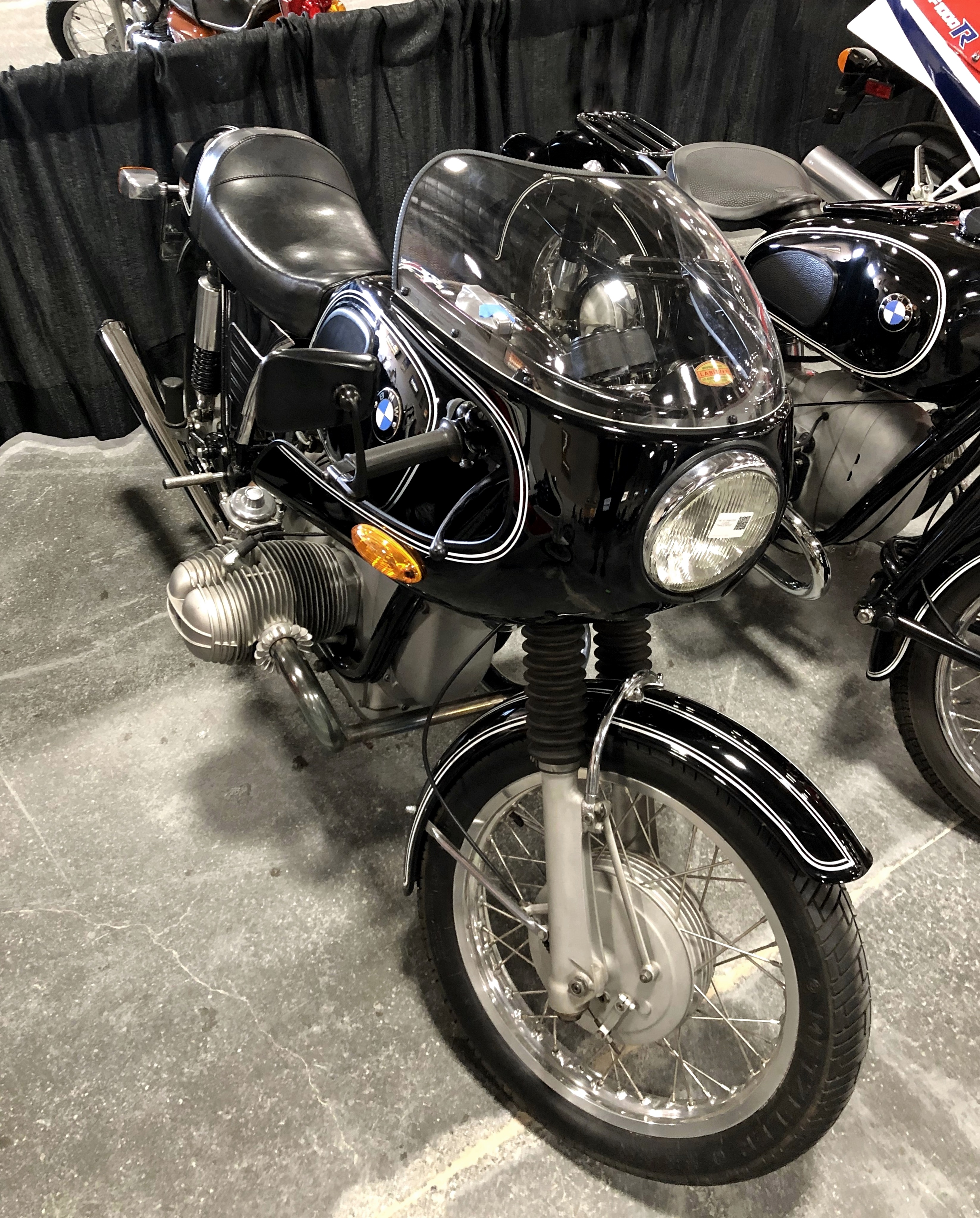

Delightfully unadorned the 750 sails through tight bends and canyon sweepers with enthusiasm. Made in oval-shaped (for strength) steel tube, the tall frame and bump-friendly suspensions limit the /5 in full sports mode. For 1970/71 the line wore a large, flat sided fuel tank with knee pads and open sides. Glittered up for 1972, a smaller, restyled tank adorned with chrome panels joined louvered side covers lashed together with thick rubber bands. Simple and effective, but not mentioned in the brochure. Stripped of its covers the /5 crankcase strongly resembles the /2 unit, but most components were new. This starts with a forged, plain bearing crankshaft, high pressure oiling and the camshaft re-positioned below, hiding the pushrod tubes. Just slightly over-square, the 745cc flat twin shows its teeth at 4000-rpm and likes to work; easily gathering speed from low rpm or humming at a sustained 90-mph. All considered, it’s still conservatively tuned but a higher lift, longer duration cam, 9.0 pistons, larger (42/38mm intake/exhaust) valves and 32mm Bing CV carburetors bumped it solidly past the /2. Nestled in its cradle, the starter’s nose reaches to the clutch and ring gear as the tunnel continues back to the airbox and breather. More carryovers from the old Boxer were the Slash Two’s dry clutch four-speed and enclosed driveshaft. Uprated as displacements increased, the basic engineering pattern lives on today.

